
Why You Have a Lot of Leads but Few Conversions: Understanding the Follow-Up Gap
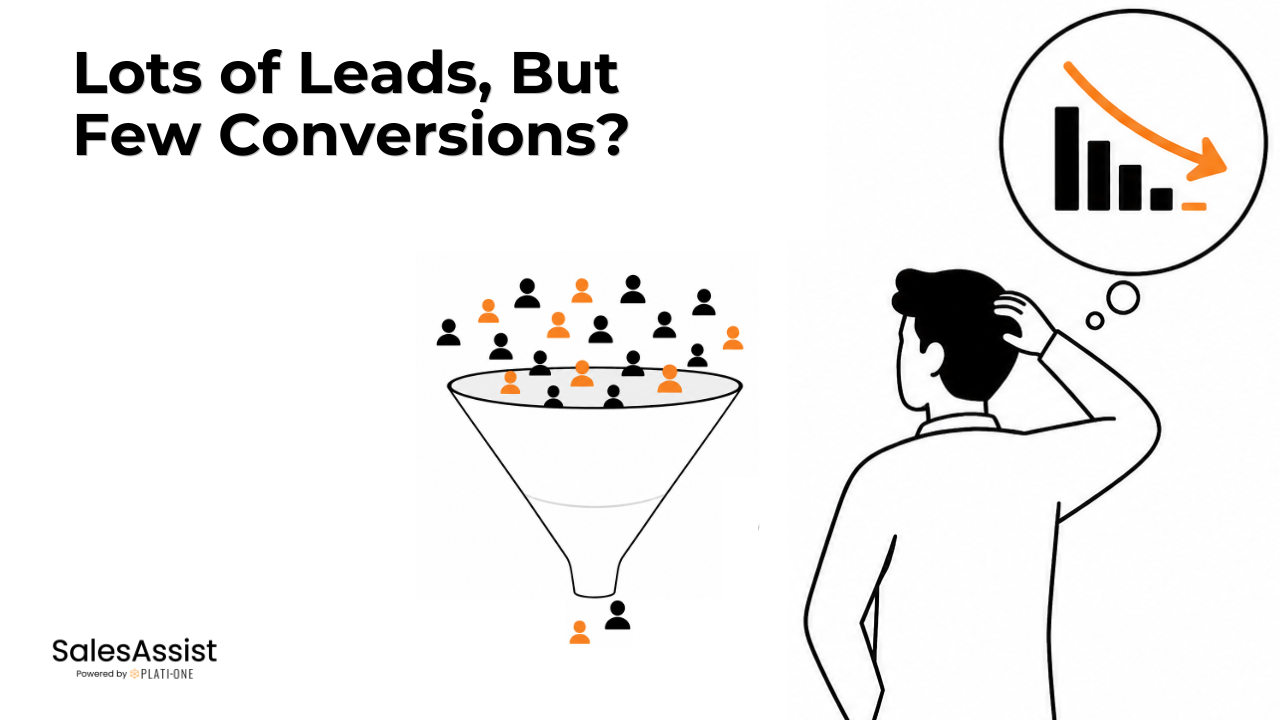
One of the most common frustrations in sales is this:
- You invest in marketing.
- You generate more leads.
- Your pipeline grows.
But conversions don't increase at the same pace.
Sometimes they don't increase at all.
In some cases, they even decline.
At first, most businesses assume the problem is lead quality.
Maybe the leads aren't serious.
Maybe the targeting is wrong.
Maybe marketing needs improvement.
But after working with sales teams across different industries, we've found that the problem is often much simpler.
You don't have a lead generation problem.
You have a follow‑up problem.
More specifically, you have a follow‑up gap.
And that gap is quietly costing businesses revenue every single day.
What Is the Follow‑Up Gap?
The follow‑up gap is the space between a lead showing interest and your sales team taking the right action at the right time.
On paper, it sounds like a small problem.
In reality, it's one of the biggest reasons businesses struggle with sales conversion rate improvement.
Here's what it looks like in practice.
A prospect submits an enquiry on Monday.
Your sales rep calls on Tuesday.
No answer.
They try again on Wednesday.
Still no response.
Then a new marketing campaign launches and generates ten additional leads.
Attention shifts.
The original lead gets pushed down the priority list.
A week later, someone remembers to follow up again.
By then, the prospect has already spoken to a competitor.
Eventually, the lead is marked as cold.
Nobody intentionally ignored the opportunity.
The lead simply fell into the follow‑up gap.
Now multiply that scenario across dozens or hundreds of leads.
That's where revenue starts disappearing.
Why More Leads Often Create More Problems
Most businesses assume more leads automatically mean more sales.
But more leads also create more complexity.
When lead volume increases, follow‑up becomes harder to manage.
What worked with 20 leads often breaks at 100.
What worked with 100 leads breaks at 500.
Without a structured system, sales teams start relying on memory, habits, and guesswork.
That's when three critical problems begin to appear.
Problem #1: Lead Prioritization Breaks Down
When sales reps have too many leads, they naturally focus on the opportunities they remember.
They call:
- The lead they spoke to yesterday
- The prospect who answers quickly
- The customer they feel comfortable talking to
- The easiest opportunity in the pipeline
What they don't necessarily call is the lead that's most likely to convert.
This creates a hidden problem.
The best opportunities aren't always the most visible opportunities.
Without lead prioritization software or a structured sales process, important leads get lost among less important ones.
Sales teams stay busy.
Conversions stay flat.
Problem #2: Context Gets Buried
Sales conversations don't happen in one place anymore.
Information is scattered across:
- Calls
- WhatsApp conversations
- Emails
- Notes
- CRM records
- Spreadsheets
When a sales rep needs to remember what happened with a lead three weeks ago, finding the answer often becomes a time‑consuming task.
So instead of spending time selling, they spend time searching.
This slows down follow‑ups and reduces sales team productivity.
The longer it takes to understand a lead's history, the more likely follow‑up gets delayed.
Problem #3: Timing Becomes Guesswork
Good sales follow‑up isn't just about consistency.
It's about timing.
Follow up too early and you risk being ignored.
Follow up too late and the opportunity may already be gone.
The challenge is that every lead moves at a different pace.
Without a structured sales follow‑up process, sales reps are forced to guess:
- Is this lead ready for another conversation?
- Should I call today or next week?
- Have I followed up too much?
- Am I waiting too long?
When timing depends on memory, mistakes become inevitable.
Why Most Businesses Are Losing More Leads Than They Realise
One of the biggest misconceptions in sales is that lost leads are obvious.
Most aren't.
Lost leads rarely announce themselves.
Instead, they quietly disappear.
- The prospect stops replying.
- The follow‑up gets delayed.
- The next action isn't scheduled.
- The conversation fades.
Eventually, everyone moves on.
Months later, nobody remembers the opportunity existed.
This is why many businesses believe they need more leads when what they actually need is better lead management.
The opportunities are already in the pipeline.
They're simply not receiving consistent attention.
The Solution Isn't Working Harder
When businesses discover follow‑up problems, the first reaction is often:
"We need the team to follow up more."
But working harder isn't the solution.
Sales teams are already busy.
The real solution is reducing the friction that causes follow‑ups to get missed in the first place.
That means creating a system where:
- Sales reps know exactly who to contact each day
- Important leads are automatically prioritized
- Communication history is instantly accessible
- Every interaction has a clear next step
- Follow‑ups are scheduled automatically
- Leads are re‑engaged before they go cold
In other words, the goal is not more effort.
The goal is better execution.
What Happens When the Follow‑Up Gap Closes
When businesses close the follow‑up gap, the results tend to appear surprisingly quickly.
- Sales reps spend less time deciding and more time selling.
- Lead engagement improves.
- Follow‑up consistency increases.
- Managers gain better visibility into execution.
- And most importantly, conversion rates improve.
Not because the company generated more leads.
But because they got more value from the leads they already had.
How Plati‑one Sales Assist Helps
Plati‑one Sales Assist was built specifically to solve the follow‑up gap.
Instead of acting as another place to store information, it acts as a Daily Sales Execution System.
Every day, sales reps know:
- Which leads need attention
- Why those leads matter
- What happened previously
- What action should happen next
The system combines lead activity, follow‑up history, workflow automation, communication tracking, and AI‑driven recommendations to help teams execute consistently.
The result is simple:
- Fewer missed follow‑up leads.
- Better sales team productivity.
- Higher engagement.
- And more conversions from the leads you already have.
Final Thoughts
If your pipeline keeps growing but conversions aren't keeping up, the problem may not be your marketing.
It may not be your sales team either.
The problem may simply be the gap between interest and action.
The follow‑up gap is invisible to most businesses until it starts affecting revenue.
The good news is that it's fixable.
Because more leads don't automatically create more sales.
Better execution does.
More posts from Plati-one
Welcome platione solution to Platione!
Contact Us
Enquiry Form
Send a product or company enquiry directly to this seller.